
Why hospital water is not domestic water
Hospitals use large volumes of water, and they need several different water qualities at the same time. A single hospital may draw drinking water, purified water, softened water and acidified water, each reserved for a specific task — hemodialysis treatment water, dental-unit water, endoscope rinsing water, instrument washing and sterilisation water in the central sterile services department (CSSD), and surgical hand-washing water. Because every one of these streams touches patient care, the safety requirement is far stricter than for an ordinary building: the system has to prevent contamination and cross-infection at every point of use.
Yueyang Maternal and Child Health Hospital, a maternal and child health hospital in Hunan Province, China, worked from exactly this brief when it upgraded the water infrastructure serving its campus.
The project at a glance
| Hospital | Yueyang Maternal and Child Health Hospital |
|---|---|
| Location | Yueyang, Hunan Province, China |
| Hospital type | Grade III-A maternal and child health hospital (the highest tier in China’s hospital classification) |
| Capacity | 1,000 planned beds (500 open) |
| Site and floor area | Approximately 100 mu of land; 175,700 m² of floor area |
| Clinical scope | 29 clinical and health departments, including obstetrics, gynaecology, paediatrics, neonatology, reproductive health and postpartum rehabilitation |
| Water system | Kertone SW2.0 smart water system |
What Kertone delivered
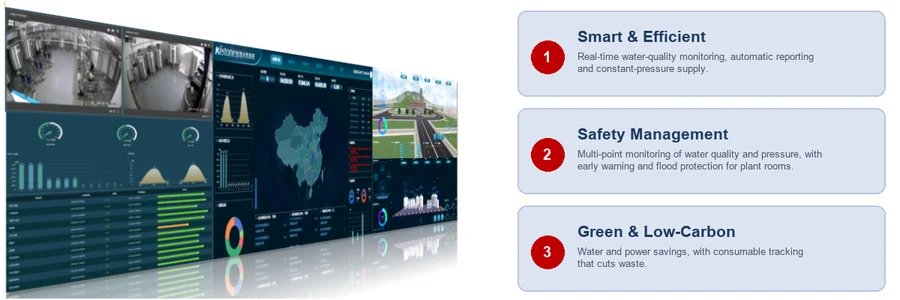
Kertone supplied an integrated smart-water solution that links the water-treatment equipment with GIS, BIM, IoT, visualisation, big-data analytics and cloud computing. The upgrade covers the whole chain — from treatment units and supply and drainage piping through to the points of use — and monitors water consumption in real time, converting the readings into usage reports for refined water management.
The same platform covers all of the hospital’s water needs, including medical purified water, direct drinking water, acidified water, and wastewater treatment. It also manages the water system across its full lifecycle through digital, visual and modular management, so equipment, piping and endpoints are tracked as one system rather than as separate installations.
Four things the system does for the hospital
- Big-data analytics centre. Flow at each network node is monitored remotely, so abnormal supply conditions are spotted quickly and regional leakage can be calculated and reduced.
- Safety centre. Water quality at every stage of treatment is monitored around the clock, with the readings shown live rather than checked on a manual schedule.
- Early-warning centre. The system analyses operating data continuously; if a water-quality reading goes out of range, it raises an alert and pushes it to the responsible staff member’s phone.
- After-sales service system. Service information is handled centrally, and past issues can be searched and traced through the historical record.
Outcome
With SW2.0 in place, the hospital keeps medical quality and safety while reducing energy and water consumption — a result that shows up both in operating cost and in service quality. The project is an example of how a hospital water system can be managed as a measurable, monitored asset rather than as a set of separate machines.
Bring the same approach to your project
If you are planning water systems for a hospital, laboratory or healthcare campus, the same engineering logic applies: match each water quality to its clinical use, then monitor it continuously. See Kertone’s hospital water solutions, browse more hospital projects, or send your project details to our engineering team.