
Technical Specifications
| RO rejection | >97.5% stable desalination |
|---|---|
| Control core | Cortex-M3 microprocessor |
| Supply mode | Variable-frequency direct supply |
| Emergency mode | Either RO stage can operate independently |
| Membrane housing | Sanitary FRP, 300 PSI design pressure |
| Operation | Automatic/manual, scheduled start/stop and night circulation |
Product Overview
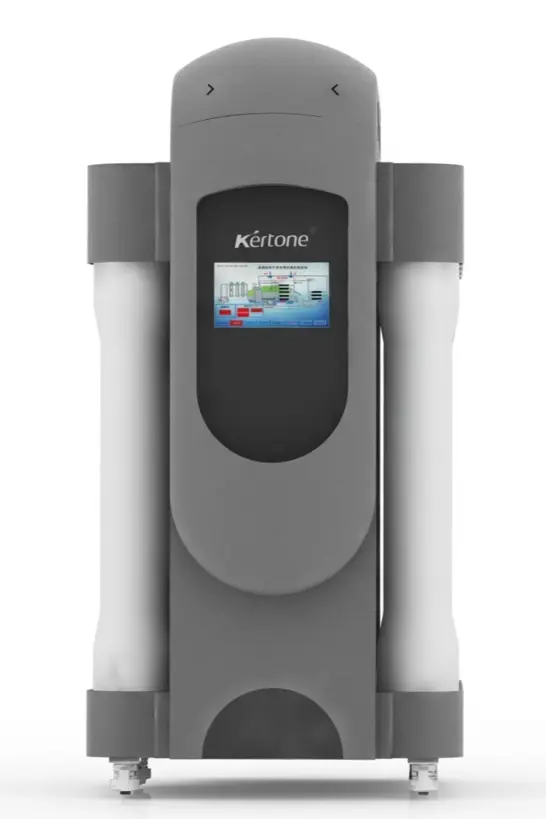
The Hemodialysis Water Treatment Robot is a highly integrated modular dialysis-water platform combining dual-stage RO, sanitary circulation, intelligent monitoring, leak protection and voice or touchscreen operation in a compact enclosed cabinet.
Key Features
ProcessDual-stage RO
Interface15-inch touchscreen + voice
PipingSanitary SUS316
Noise<75 dBA
System Design & Functions
- Real-time source-water and product-water conductivity monitoring with multi-point digital sensors.
- Dual variable-frequency pump control stabilizes loop pressure and protects dialysis operation from pressure fluctuations.
- Emergency single-stage operation supports continued water supply if either RO stage is unavailable.
- Voice commands and a permission-controlled 15-inch touchscreen provide two operating methods.
- Leak detection can close the inlet valve, stop the system and issue an alarm.
- Sanitary SUS316 piping uses argon-protected welding and passivated internal surfaces.
- Automatic flushing, chemical cleaning connections, thermal and chemical disinfection modules support hygiene management.
- IoT consumable tracking, intelligent fault analysis and remote service reduce diagnostic time.
Applications
- Hemodialysis centers and hospital blood-purification departments.
- New dialysis-water rooms and modular upgrades requiring compact equipment.
Installation & Integration
- Project-specific feed-water analysis, capacity calculation and loop design are required.
- Provide drainage, grounded power, ventilation, service clearance and network access.
- Commissioning and water-quality validation must be completed before treatment use.
Standards & Service References
- System design and validation must follow the applicable dialysis-water requirements of the destination facility.
- Automatic monitoring, alarms and remote access support but do not replace clinical water-quality testing.
- Operator training, preventive inspection and documented maintenance are recommended.