
1. Your water report — which numbers are the real red lines
TDS tells you how hard the membrane has to work and what salt rejection you can expect. Hardness tells you about calcium and magnesium scaling. Both are necessary, and both are already on every spec sheet. Neither of them tells you whether your concentrate stream will precipitate barium sulfate, plate silica, or bury the first element in iron hydroxide.
Those risks come from trace components. In most natural waters, dissolved silica alone ranges from 1 to 100 mg/L (DuPont FilmTec™ RO Technical Manual, §2.4.7), and the other four ions are present at concentrations where a single wrong assumption about the concentrate side can mean scaling within weeks.
This article covers five ions and one companion anion. Together they account for the failure modes that surprise otherwise competent designs.
| The ion | What it controls | Where it bites |
|---|---|---|
| Silica (SiO₂) | Scales as a function of recovery, temperature and pH — not a fixed limit | Concentrate side, especially above neutral pH |
| Iron and manganese | Fouls even when the sample looks clean and SDI is low | Membrane surface, after oxidation |
| Barium and strontium | Sulfate salts so insoluble that the risk level is measured in µg/L | Concentrate side, together with sulfate |
| Sulfate (SO₄²⁻) | The anion that turns barium and strontium into a scaling event | Concentrate side |
The goal is not to teach chemistry. The goal is to give you a decision method you can apply to your own report today.
2. Barium and strontium — two numbers lower than your intuition
This is the section that changes how people read a report. The instinct is that “trace” means “negligible.” For barium sulfate it does not.
Barium sulfate is the least soluble of all alkaline-earth metal sulfates. In most natural waters, barium is already present at a level high enough to cause barium sulfate precipitation on the concentrate side of an RO system (DuPont FilmTec™ RO Technical Manual, §2.4.4). The critical feed concentration can be astonishingly low:
| Water type | Maximum permissible feed barium |
|---|---|
| Seawater | < 15 µg/L |
| Brackish water | < 5 µg/L |
| Brackish water with sulfuric acid dosing | < 2 µg/L |
That is micrograms per litre — five orders of magnitude below the TDS figures everyone worries about. Worse, barium sulfate precipitation can act as a catalyst for calcium sulfate and strontium sulfate scaling, so one overlooked ion triggers two more.
For strontium, the judgment uses a safety factor. When the concentrate-side ionic product IPc ≥ 0.8 × Ksp, the system is at scaling risk and the design must be adjusted (§2.4.5). The method is identical for both ions:
- Calculate the concentrate-side ionic strength from your recovery.
- Compute the ionic product of Ba²⁺/Sr²⁺ with SO₄²⁻ at that concentration.
- Compare against the temperature-corrected Ksp; apply the 0.8 safety factor for strontium.
If you cannot do step 2 by hand, this is exactly the calculation a pretreatment specialist should run for you — and the number you should ask to see. See how Kertone specifies recovery and antiscalant against these limits.
3. Silica — a variable decided by solubility and pH
Silica has no single “safe limit.” The permissible concentrate-side SiO₂ concentration is whatever the silica solubility is under your specific conditions (§2.4.7). It moves with three things: recovery, temperature, and pH.
Below neutral pH, silica stays as weakly ionized silicic acid and is relatively manageable. Above neutral pH it dissociates into silicate ions, which then form insoluble silicates with calcium, magnesium, iron, manganese and aluminum. Aluminum is the strongest precipitant of silica there is — which is why silica scaling almost always shows up together with aluminum or iron, never alone.
Two rules follow directly:
- Even when silica is below saturation, both Al³⁺ and Fe³⁺ must stay below 0.05 mg/L or silicate precipitation still occurs.
- You need four inputs to judge silica risk: SiO₂ concentration, temperature, pH, and total alkalinity.
The decision flow is mechanical:
- Feed SiO₂ × (1 ÷ (1 − recovery)) → concentrate-side SiO₂.
- Look up silica solubility at your operating temperature.
- Apply the pH correction factor.
- If concentrate SiO₂ exceeds the corrected solubility, you have a scaling risk.
Remedies run from feed acidification and preventive acid cleaning, to — when colloidal silica or silicates are present — coagulation-filtration followed by sub-micron (≤ 1 µm) fine filtration. The lever most buyers never test is recovery: a few percent lower recovery often clears the silica limit without any extra equipment.
4. Iron and manganese — why “clean-looking water” still fouls membranes
The second assumption this article breaks: a low iron number means a safe feed. It does not.
Iron fouling is among the most common RO failure modes. It cuts permeate flux and, separately, makes the membrane more vulnerable to oxidative damage (§2.9). The sentence every designer should write on the wall:
Even with SDI below 5 and feed iron below 0.1 mg/L, iron fouling problems can still form.
Iron fouls more often than manganese because iron oxidizes at a lower pH. The trigger is almost always oxidation: if water carrying Fe²⁺/Mn²⁺ dissolves more than 5 mg/L of oxygen, or is chlorinated, the soluble ferrous ion converts to insoluble ferric hydroxide colloid — exactly the particle size that plates onto a membrane. The one safe window is anaerobic: at pH < 6 and dissolved oxygen < 0.5 mg/L, feed Fe²⁺ may reach up to 4 mg/L.
Iron arrives from six directions, and a good pretreatment review checks all of them: oxygen-free aquifers containing dissolved Fe²⁺/Mn²⁺; oxidized iron/manganese hydroxide flocs already in the raw water; iron-complexed natural organic matter; coagulation flocs from upstream treatment; corrosion products from pipework; and iron-bearing silicates. Anaerobic trains add four more: oxygen ingress, insoluble ferrosilicate formation, iron-reducing bacteria accelerating biofilm, and — if the source also carries H₂S — black ferrous sulfide precipitates.
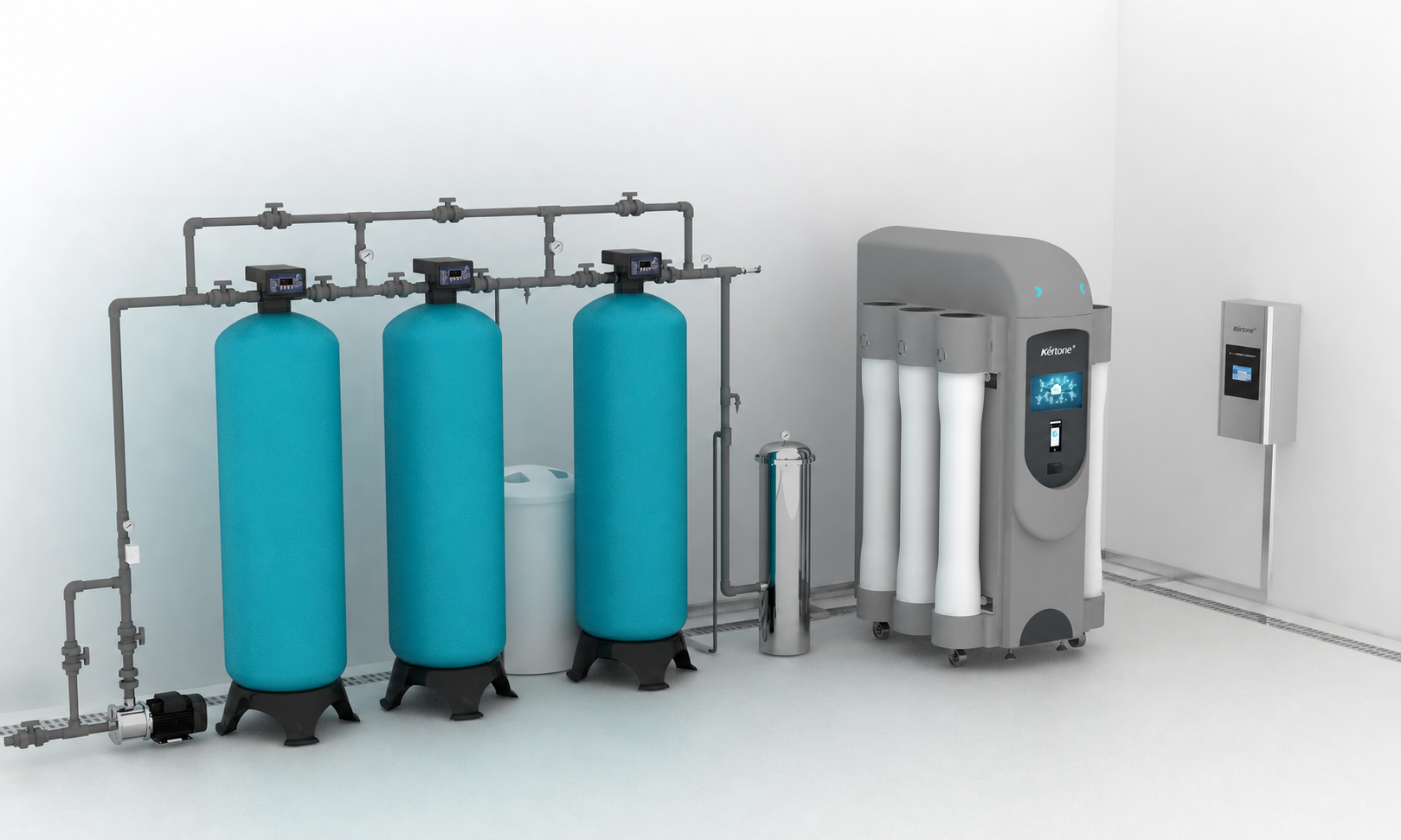
Where oxidation is the mechanism, the fix is usually oxidation filtration upstream of the RO, sized to the actual ferrous load rather than the total iron on the report. Kertone case studies show the train combinations used on iron- and manganese-rich feeds.
5. Aluminum — 50 ppb is enough to drag performance down
Aluminum is the quiet one. It is rarely on a buyer’s checklist, yet it links directly to a procurement decision you may have already made: your coagulant.
Extremely low aluminum — on the order of 50 ppb — can already depress performance, and as little as 10 mg/L of silica can trigger aluminosilicate fouling (§2.10). The manual’s recommendation is blunt: do not use aluminum-based coagulants; switch to iron-based products.
The pH detail matters for both stages. Aluminum solubility is lowest at pH 6.5, so coagulation belongs at that pH; the RO itself should run at pH 7–9. There is also a trap with antiscalants: polymer-based antiscalants are sensitive to iron and aluminum, and the wrong selection does not just under-perform — it fails outright and accelerates fouling. Keep feed aluminum under 0.05 mg/L.
For a buyer, the takeaway is a single question to put to any vendor: “What coagulant does your pretreatment use, and where does the aluminum end up?” The answer tells you more about long-term flux than the quoted rejection rate does.
6. From water report to configuration — a reusable workflow
Sections 2–5 are individual judgments. String them together and you get the decision chain that separates a specification from a guess.
| Step | Action | Threshold / note |
|---|---|---|
| 1 | Circle the ions on your report: silica, iron, manganese, barium, strontium — and sulfate. | — |
| 2 | Barium / strontium: compute the concentrate-side ionic product with sulfate. | IPc ≥ 0.8 × Ksp (strontium) |
| 3 | Silica: compute concentrate solubility at your target recovery, temperature and pH. | Concentrate SiO₂ vs corrected solubility |
| 4 | Iron / manganese: judge the oxidation condition, not just the concentration. | Fe²⁺ up to 4 mg/L only at pH < 6 and DO < 0.5 mg/L |
| 5 | Aluminum: confirm the coagulant is not aluminum-based. | Feed Al < 0.05 mg/L |
| 6 | Decide the pretreatment train, the antiscalant and its dosing point, and the maximum recovery. | — |
Steps 2–5 each carry a hard threshold from the sections above. Step 6 is where those thresholds become equipment. If two or more ions trip at your desired recovery, recovery — not another chemical — is usually the first lever to pull.
7. Sampling checklist — measure what needs measuring
A common cause of redesign is a report that simply omits the ions above. If your analysis does not list barium, strontium, manganese and silica separately, the design was built on assumptions. The standard methods below are the ones membrane manufacturers expect to see cited (DuPont FilmTec™ RO Technical Manual, §2.2):
| Parameter | ASTM | Standard Methods |
|---|---|---|
| Manganese | D858 | 3500-Mn |
| Silica | D859 | 4500-Silica |
| Iron | D1068 | 3500-Fe |
| Strontium | D3352 | 3500-Sr |
| Barium | D4382 | 3500-Ba |
When you request a water analysis for RO design, require these five by name. A vendor who returns a report without them has not given you enough to specify a system safely.
8. Worked example — reading one water analysis end to end
Illustrative example. The values below are representative of a brackish groundwater and demonstrate the method; they are not a specific Kertone client project.
| Parameter | Value | Parameter | Value |
|---|---|---|---|
| SiO₂ | 25 mg/L | Ba²⁺ | 8 µg/L |
| Fe²⁺ (anoxic, DO < 0.5 mg/L) | 1.2 mg/L | Sr²⁺ | 1.5 mg/L |
| Mn²⁺ | 0.3 mg/L | SO₄²⁻ | 180 mg/L |
| pH | 7.8 | Temperature | 20 °C |
| Target recovery | 75% | — | — |
| Parameter | Reading | Action |
|---|---|---|
| Barium | 8 µg/L feed; ~32 µg/L at 75% recovery — above the < 5 µg/L brackish limit | BaSO₄-rated antiscalant; reduce recovery |
| Strontium | 1.5 mg/L with 180 mg/L sulfate — check IPc against 0.8 × Ksp | Usually trips together with barium |
| Silica | 25 → 100 mg/L concentrate; manageable at 20 °C / pH 7.8 | Hold pH and recovery — a 5-point rise changes the answer |
| Iron / manganese | Fe²⁺ 1.2 mg/L at pH 7.8 — outside the safe anaerobic window (pH < 6) | Oxidation filtration upstream of the RO |
| Aluminum | Not reported | Request it, and check the upstream coagulant |
The reading is unambiguous: this water needs a barium-/strontium-rated antiscalant, oxidation filtration for iron and manganese, and a recovery below 75%. A design that quoted 75% recovery on TDS alone would have scaled within months. That is the difference the five ions make.
If your own report raises one of these flags and you want a second reading, send it to Kertone engineering — we will run the concentrate-side calculations against your actual recovery target.
References
DuPont. FilmTec™ Reverse Osmosis Membranes Technical Manual. Form No. 45-D01504-en, Rev. 20, DuPont Water Solutions, Aug. 2026. Sections 2.2, 2.4.4, 2.4.5, 2.4.7, 2.9, 2.10.
Google. “Control Your Snippets” and “Influencing Your Title Links.” Google Search Central.